
-

This website is the ramblings of The Pithole Hermit, living on his land in a cabin, off-grid, in northwest Pennsylvania.
Includes wild edibles, farming, primitive living, weapons systems and other off-grid subjects. And a few electronic projects along the way.
Category Archives: Wild Edibles Recipes
Pickled Milkweed Pods
(These recipes are a work in progress for the Hermit to store gathered recipes or ideas. Many have not been tried or perfected. Try them at your own risk.)
I have eaten many boiled milkweed pods. This year I am trying out pickling them. This is a basic pickling recipe I will try as soon as the pods are ready. As of today some plants already have pods but most are still in the flowering stage. Don’t wait too long to collect or the fluff starts to develop inside. I like about 1 to 2 inch pods. They are crunchier.
Pickled Milkweed Pods
8 cups young milkweed pods
2 cups vinegar
1 cup water
1 tbsp pickling salt
1 cup lemon juice (or more vinegar if desired)
Spices as desired (ie. cloves, garlic, onion, pepper)
Pack jars with pods
Mix other ingredient and bring to boil
Add hot liquid to the jars
Water bath for 10 minutes if desired (not needed as vinegar preserves)
_________________________________________________
Here is how I actually prepared them.
I gathered and cleaned them.
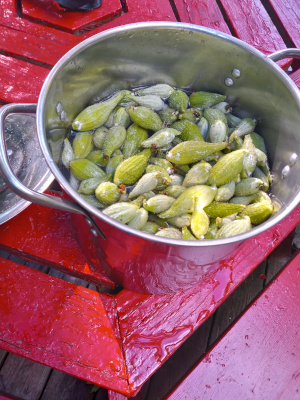
I lightly simmered for a few minutes to wash away some latex. Not all but most washed out.
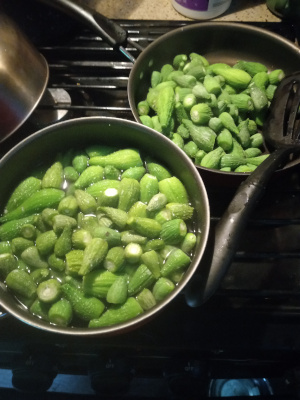
From there I veered off the recipe.
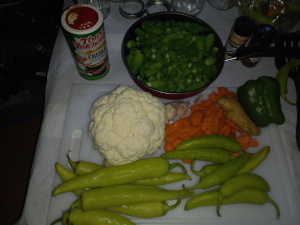
That’s right. I added them to hot peppers, carrots, brocolli, garlic and ginger.
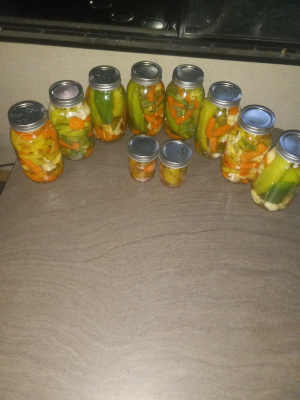
I simply packed the jars, added about half a tsp canning salt and some Creole seasoning. Then I boiled half vinegar and half water. Poured the hot vinegar water over the hot mix and put the lids on.
That’s it. No water bath. No pressure. Just crunchy vinegar pickled vegetables.
This is the same basic hot mix I made with my dad for years. I just added milkweed pods
As the jars cool the lids vacuum seal. We kept them through the winter lined up on our basement wall with all of our other canned vegetables and soups. We never owned a pressure canner.
And by the way. I know the internet has made everyone scared of living. So much so that you will be told if you don’t pressure can most low acid vegetables or meats you will die.
Guess what? Even if you do everything correct, sterilize everything and pressure cook everything until it is mush it is STILL possible that a botulism spore could be hiding in a jar.
Pressure canners were not even available to most until relatively recently.
So how did we survive?
Very simple. Vegetables that are not high acid or have acid vinegar added were just water bathed. This kills bacteria, including botulism. It does not kill the botulism spores. So over time the spores CAN (not always or even very often) develop into bacteria and the bacteria produce toxins (Bo-tox that makes certain politicians look like wax mannequins) that can kill you.
But you don’t just crack the jar open and pour it down your throat.
The growth of bacteria cause gas which will break the seal.
It also makes the food look bad. When you open it it will smell bad.
At that point you throw it out.
But in reality you could still eat it.
Botulism bacteria itself can be eaten. Your stomach will kill it.
And most importantly don’t eat your food raw.
EVEN IF YOU DID THE FANCY PRESSURE COOKER AT LEAST HEAT IT.
Heating the food will kill the bacteria AND it will neutralize (officially called denature) the botulism toxin.
All it takes is 160 degrees for about 5 mintues (not even boiling although it is best to bring to a boil). Not even regular cooking.
OUR ANCESTORS NEW THIS COMMON SENSE EVEN BEFORE THEY KNEW OF BACTERIA!
The only part of botulism that is deadly is the toxin that you just neutralized (made safe) by heating it.
In summary. Heat those water bathed beans, even if you ignore all the other signs that they went bad or enjoy eating rotten, smelly beans, and you will be fine.
There are plenty other bacteria that might not kill you but could make you sick. (stomach ache and diarrhea).
High heat will also take care of them but the food will still taste and smell just as bad.
And finally…
Shockingly, this applies to canning meat too.
I know. You’ve been told on the internet that people are dropping dead everywhere by not pressure canning their meat.
If you have a pressure canner go ahead a use it and feel superior in your belief that you will never get sick again. You still could anyway because you get cocky thinking you are protected and not heat your food.
But if you aren’t independently wealthy, or the seal failed on your pressure canner and you have no way to replace it, you can water bath canned meat too. JUST COOK IT BEFORE YOU EAT IT. And as always pay attention to the normal signs of spoilage. It isn’t rocket surgery.
Like I said, even if you followed all safety rules for pressure canning, botulism could still form so you could get very sick eating ANYTHING not well pickled, right out of the jar.
Cook it after opening.
Of course this doesn’t apply to higher acid items such as jams and preserves. Or items pickled in vinegar.
And by the way, many of my canning recipes are vinegar pickling. This is because I like vinegar. And also I am lazy and vinegar pickling is very easy. I keep saying vinegar pickling because there is also fermentation pickling which I might cover later. This actually uses good bacteria to preserve by blocking out bad bacteria. Sauerkraut is a form of this. As a kid I punched a lot of cabbage in a crock down in the basement.
Posted in Wild Edibles Recipes
Comments Off on Pickled Milkweed Pods